
Canada between global conflict and the structural pressure of everyday life.
Wars rarely stay where they start.
They begin with missiles, drones, air defenses, and maps full of red arrows. But their consequences travel along pipelines, shipping routes, insurance markets, food systems, and financial networks. By the time the shock reaches ordinary people thousands of kilometers away, it no longer looks like war. It looks like a slightly higher grocery bill. The gas price that refuses to fall. A mortgage renewal that suddenly costs hundreds more per month.
War is often driven by the pursuit of resources, power, or strategic advantage. But the price is rarely paid by those who start it. It is paid by ordinary people — often by other people’s children.
For Canadians, the conflict unfolding in the Middle East may seem distant. Yet the systems that structure modern life are tightly interconnected. Energy flows, logistics chains, global capital markets, and insurance networks bind societies together. When one part of that system destabilizes, the pressure propagates outward.
Meanwhile, in the Middle East itself, the consequences are immediate and devastating: damaged hospitals, disrupted water infrastructure, closed airports, displaced families, and cities where daily life becomes fragile.
Two different realities. One shared system. One real problem: a system organized to maximize throughput, concentration, and short-term returns is not well designed for human resilience.
Canada is not fragile only because of war abroad. The war is a shock, but it is landing on top of pre-existing structural weakness.
| Pressure | Direction | Evidence |
|---|---|---|
| Housing affordability | ▲ major increase | Price-to-income ratio rose sharply since 2004 (missingmiddleinitiative.ca) |
| Household debt | ▲ very high | Debt-to-income ≈ 175% (Statistics Canada) |
| Food costs | ▲ persistent pressure | Food inflation often above CPI (Reuters) |
| Debt service | ▲ near historical highs | ≈14.4% of income used for debt payments (OECD) |
Canada enters this moment already under economic strain. I can give you data from statistical sources, but I’m living through all this every day.
- Over the past decade, housing prices have surged. Household debt has climbed to some of the highest levels in the developed world.
- Grocery prices have risen steadily. I do the math every month and is not good. It also not justified by anythign else than corporate greed and factual oligopolies.
- Telecommunications costs remain elevated relative to peer countries. A roaming European number and data subscription you can use every day in Canada is cheaper than a Canadian one.
- Interest rates increased rapidly after years of cheap borrowing.
None of these pressures were caused by the current conflict. But the war amplifies them.
Enter politicians’ favorite pastime: war. The transmission mechanism is not mysterious:
- Hormuz disruption raises oil and shipping costs.
- Shipping and war risk insurance costs feed into delivered prices.
- Energy and freight costs pass into fuel, food, airline travel, and imported goods.
- If inflation broadens, rate relief becomes harder, and debt stress deepens.
Canada’s pressure points are structural, not temporary. None of these pressures were caused by the current conflict.
Energy and Distance
Canada is a large country where distance is unavoidable. Food travels thousands of kilometers. Goods move across vast regions by truck, rail, ship, and air. When fuel prices rise, transportation costs ripple across the entire economy. A few cents more for gas may seem trivial. But multiplied across freight networks, delivery services, airline fleets, and agricultural equipment, the increase spreads everywhere. Consumers see it later in grocery aisles, delivery charges, airline tickets, and utility bills.
The Grocery Pressure
Food prices are one of the most visible indicators of economic stress. Canada’s grocery market is dominated by a small number of large retailers. While concentration does not automatically imply wrongdoing, it does reduce competitive pressure. When costs rise anywhere along the supply chain infuel, fertilizer, packaging, refrigeration, trucking, those increases tend to reach consumers quickly.
Savings shrink. Discretionary spending disappears. Unexpected expenses become harder to absorb.
Connectivity as Necessity
In the twenty-first century, digital connectivity is no longer optional. Work, education, banking, and government services increasingly depend on internet access and mobile networks. Canada’s telecommunications sector is dominated by a few major companies, including Bell Canada, Rogers Communications, and Telus. Limited competition has historically kept prices relatively high compared to many other developed economies. When connectivity costs remain high while housing, food, and transportation costs are rising simultaneously, households have fewer ways to rebalance their budgets.
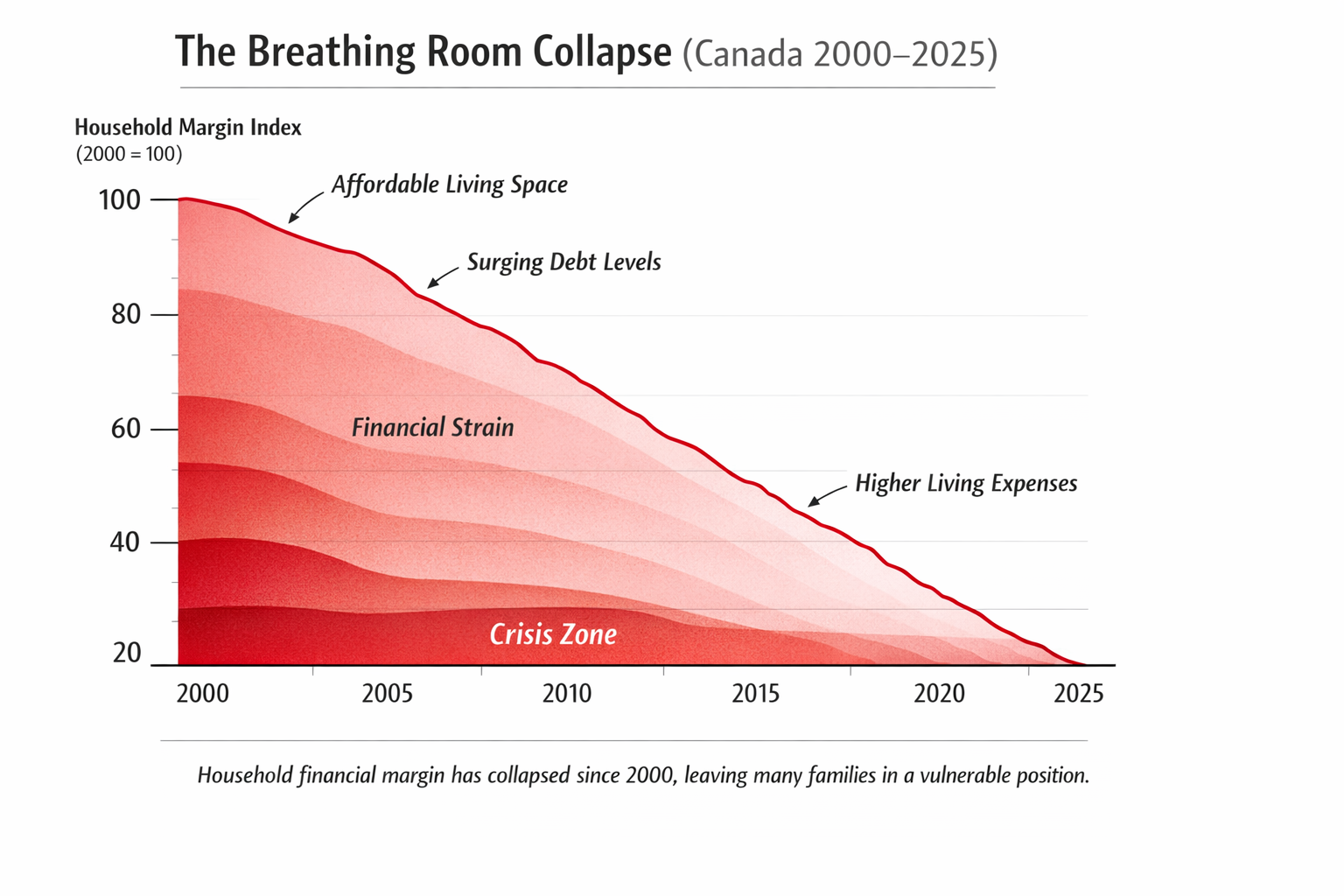
The economic space within which families make decisions begins to shrink.
Debt and Interest
Canada’s household debt levels amplify every external shock. For years, low interest rates encouraged borrowing, particularly in housing markets. Now many mortgages are renewing at higher rates. Even modest increases in monthly payments can significantly affect household budgets. If global energy shocks push inflation higher again, interest rates may remain elevated longer than borrowers expected. The result is a feedback loop: higher costs reduce spending, slower spending slows the economy, and financial stress spreads quietly through households.
Meanwhile: the reality of war
If Canada shows us the economic version of suffocation, the Middle East shows us the literal one.
WHO, UNICEF, and UN reporting describe attacks on health infrastructure, the killing of children, mass displacement, damaged service systems, and rising risk around water and medical access. Reuters and UN agencies have also reported that aid corridors are being obstructed and that displacement has widened across the region.
One of the most alarming research findings concerns water. A peer-reviewed study cited in the research above notes that desalination provides over 20% of total water used across GCC countries and over 50% in Bahrain, Kuwait, Qatar, and the UAE. That makes water infrastructure not just an engineering issue, but a civilizational vulnerability.
So the contrast is stark:
In Canada, system stress means less affordability, less flexibility, and less stability.
In the Middle East, system stress means destroyed hospitals, unsafe water, closed corridors, displacement, and death.
Different intensity, same architecture: when a system is built for extraction rather than resilience, ordinary people absorb the damage first.
There is a moral component that should surpass the economic.
Question: Are institutions arranged to improve the position of the least advantaged?
The answer here is uncomfortable. If an energy shock, a logistics shock, or a war shock quickly reduces food security, housing stability, and access to basic services, then the institutional design is failing that test.
Question: Can affluent societies ignore distant suffering simply because it is geographically remote.
Answer: It is difficult to sustain when the same system that carries our consumer abundance also carries war risk, displaced people, oil shocks, and blocked aid.
Question: Why, over recent decades, growth has often translated into concentrated wealth at the top and narrowed breathing room below?
Answer: Thomas Piketty argues that future declines in economic growth will likely lead to dramatic concentrations of economic and political power through the accumulation of capital (or wealth) by the very richest. People with assets, pricing power, or hedges are buffered. People with debt, rent exposure, and no bargaining power are not.
Rethinking the System
Several contemporary thinkers have proposed alternative frameworks for designing economic systems that prioritize resilience and shared prosperity.
Each addresses a different weakness in the current model.
Regenerative Economics
Economist Kate Raworth argues that economies should operate within ecological limits while guaranteeing basic social foundations such as food, housing, healthcare, and energy.
Affordability not a side effect of growth but as a constraint in the societal design. Energy, food, housing, telecom, and transportation should be judged by whether they keep people above a livable floor while reducing exposure to ecologically and geopolitically dangerous dependencies.
What this would mean in practice:
- Build a national resilience floor: guaranteed access thresholds for food, energy, connectivity, and shelter.
- Accelerate distributed clean energy, home retrofits, and local storage so global oil shocks have less influence over household life.
- Treat basic digital access as part of the social floor, not a premium service.
Decentralized Ownership
Economist Yanis Varoufakis has argued that digital and technological infrastructure should not be controlled exclusively by concentrated private power. In a world where connectivity determines participation in society, more decentralized forms of ownership like public, cooperative, or community-based, could improve economic fairness and resilience.
In Canada, this matters because telecom and digital access are essential, yet ownership and pricing power remain highly concentrated. Applied here, the lesson is: if citizens depend on digital systems to work, learn, transact, and organize, then concentrated private control over those systems becomes a democratic issue.
What this would mean in practice:
- Expand public, municipal, and cooperative broadband models.
- Support data and digital platform cooperatives where communities or users share governance rights.
- Create public-interest digital infrastructure standards so key communication systems are not organized purely around shareholder extraction.
Mission-Oriented Economics
Economist Mariana Mazzucato advocates for mission-driven public policy.
Rather than reacting to crises after they occur, governments could define clear national goals—such as affordable housing, energy resilience, or climate transition—and organize public and private investment around achieving them.
Canada’s problem is that too much policy remains reactive. We wait for inflation, then fight inflation. We wait for housing crises, then subsidize demand. We wait for telecom concentration, then complain about prices. Mazzucato’s framework would ask Canada to define national missions.
What this would mean in practice:
- A mission for affordability resilience: reduce household exposure to food, fuel, housing, and connectivity shocks.
- A mission for internal market integration: remove interprovincial barriers as a nation-building project, not a technical afterthought.
- A mission for strategic essentials: map and secure critical imports, domestic substitutes, and logistics redundancies before the next crisis.
The Commons
Writer and environmental thinker George Monbiot emphasizes the importance of the Commons: resources managed collectively for public benefit rather than purely through markets or centralized authority. The Commons is not nostalgia. It is a governance principle: some goods should be managed collectively because they are too essential to be left to pure market power or remote bureaucracy.
What this would mean in practice:
- Community energy co-ops.
- Community food hubs, bulk buying networks, and local storage systems.
- Public-interest land trusts for housing and essential urban land.
- Commons-based stewardship of water, local broadband, and neighborhood infrastructure where appropriate.
Expanding the Breathing Room
Taken together, these ideas point toward a broader principle. Resilient societies are designed so that ordinary people maintain an economic space within which they can absorb shocks without falling into crisis.
That margin can be expanded through several structural improvements:
- Reducing unnecessary interprovincial trade barriers to increase competition and efficiency.
- Encouraging greater competition in sectors such as groceries and telecommunications.
- Investing in distributed energy systems that reduce vulnerability to global energy shocks.
- Strengthening social safety nets and housing affordability to reduce financial fragility.
- Supporting cooperative and community-based ownership models in essential services.
These are not utopian proposals. They are practical strategies for increasing resilience.
The real question
The war has exposed the system. The question is whether Canada will scrumble to absorb the shock or learn from it.
A society that depends on fragile global energy corridors, tolerates high fixed household costs, and permits concentration in essentials is not neutral. It is making a political choice about who should bear uncertainty.
Right now, the answer is clear: civilians in the Middle East bear it in blood and displacement; ordinary Canadians bear it in shrinking margins, fixed-bill pressure, and delayed stability.
Breathing Room as a Measure of Success
Economic systems are often judged by growth rates, market indices, or productivity statistics. But those indicators do not necessarily capture how people actually experience economic life.
A more meaningful measure might be simpler: Do people feel they have room to breathe?
Room to manage expenses. Room to save. Room to plan for the future. Room to weather unexpected events. Room to live with dignity.
When that breathing room disappears, societies become brittle. And brittle systems break under pressure.
The war in the Middle East reminds us how fragile global stability can be. For Canadians, the challenge is not only to respond to shocks as they arrive, but to build an economic system that leaves more space for people to live stable, dignified lives before the next shock arrives.
Because the most important infrastructure any society possesses is not pipelines or shipping routes. It is the breathing room its citizens have to live.
We do not need a utopia to change that.
We need a model that starts from a simpler premise: the economy should not be a machine people serve. It should be an infrastructure that protects their ability to live, plan, participate, and breathe.