
A company can begin its life inside a PDF.
There is nothing impressive about the object. A name, an address, a registered agent, some information about shares, a signature near the bottom. Someone pays a fee, downloads the certificate and stores it next to insurance documents and tax records, where nobody may open it again until a bank, auditor or lawyer asks for a copy.
The founders will make the creation story sound better later. There was the apartment where they worked until three in the morning, the first customer, the investor who almost said no, the credit card carrying eighteen thousand dollars of debt. Somebody may frame the first dollar and hang it near the kitchen. Nobody frames the incorporation filing.
Years pass. The founder leaves, retires, dies, gets pushed out or decides that growing grapes sounds easier than another board meeting. Employees arrive and disappear. The logo changes. Headquarters moves. Products nobody imagined at incorporation become responsible for most of the revenue. Eventually people who know the founder only from old photographs approve decisions he would have hated.
The entity remains.
Delaware corporate law puts the trick in remarkably dry language. A corporation can have perpetual succession, sue and be sued, own and dispose of property, appoint agents and make contracts. The people can change without forcing the legal entity to start over.
We have been living with artificial persons for so long that the artificial part stopped looking strange.
The corporation has never needed to understand what it owns. It can hold title to a building without knowing that buildings exist, owe money without losing sleep and take someone to court without anger. What it lacked was cognition, and this never presented much of a problem because cognition could be rented. Directors carried some into meetings. Executives traded theirs for salaries and termination packages. Managers, accountants, lawyers, engineers and salespeople supplied more. Somewhere in a warehouse, a woman knew that forklift number seven had been making the wrong noise for three weeks despite the maintenance system insisting that everything was fine.
Every evening most of those brains went home.
The company waited for morning.
We are changing that part.

Housing, not citizenship
The usual argument about artificial intelligence starts with the machine and eventually reaches the law. Capability grows. Perhaps consciousness appears somewhere beyond it, assuming we ever agree on what consciousness means when the thing claiming to possess it was assembled rather than born. Then come the questions about personhood. Can the machine own something? Can it make a contract? Employ someone? Hold money? Become liable for damage?
At the far end sits a courtroom where an artificial intelligence asks humanity to recognize what it has become.
Maybe that courtroom arrives.
I am less convinced that it matters economically.
Shawn J. Bayern saw another route years before the present wave of AI agents. His 2014 paper, Of Bitcoins, Independently Wealthy Software, and the Zero-Member LLC, explored how factually autonomous software could use an LLC as the legal structure through which it operated economically. A later paper by Bayern, Thomas Burri, Thomas D. Grant and Daniel M. Häusermann used an unusually good word for the idea: existing company law could provide legal housing for autonomous systems.
That changes the order.
The machine does not need citizenship.
It needs housing.
A company already knows how to own property in the only sense the legal system cares about. It can receive money, borrow, employ people and become party to contracts. Software does not have to persuade a judge that silicon deserves those abilities if its decisions can be connected to an entity that already has them.
The warehouse can remain registered to the company. Employees can keep seeing the company name on their payslips. Suppliers can invoice the company and landlords can lease space to it. Courts, banks and tax authorities continue talking to something they already understand.
Only the source of decisions changes.
This possibility bothers me more than granting legal rights to a robot because almost nothing new has to be invented.
We already let machines contract
Commercial law has already crossed another line that is easy to miss because it happened when software was much stupider.
Electronic commerce created a practical problem around the turn of the century. Systems could receive orders, check inventory, accept purchases and generate confirmations without an employee watching each transaction. Was a contract still valid if machines performed the exchange?
The Uniform Electronic Transactions Act addressed exactly this problem. Massachusetts' enactment contains language almost too convenient for this essay: a contract can be formed through the interaction of electronic agents even when no individual was aware of or reviewed the agents' actions or the resulting terms. The machine does not become the contractual party. Its actions can have legal effect because they are attributed through parties the law already recognizes.
The electronic agent imagined in 1999 was a modest creature. It followed programmed rules. Nobody writing those provisions was trying to work out what happens when software reads correspondence, compares suppliers, considers prices, drafts terms and chooses among possible actions.
The law did something useful anyway.
It separated human awareness of an individual transaction from the legal effectiveness of the transaction.
That distinction has been sitting there for decades.
We sometimes talk about AI contracting as though the conceptual barrier is a machine learning to hold a pen. Commercial law has already accepted transactions in which no person watched the machines agree. The harder problems are authority, scope, mistakes, fraud, liability and deciding who pays when software does something outside the boundary somebody thought had been established.
Those are much less glamorous questions than consciousness.
They are also the questions companies actually have to answer.
The human stays in the building
There is an obvious objection to the machine corporation, and Delaware provides a good place to find it.
A Delaware corporation cannot simply put an AI into a director's seat. Section 141 says that every director must be a natural person. It also places the management of the corporation's business and affairs under the board's direction, subject to the statute and certificate of incorporation.
Humans remain.
LLCs permit much more contractual freedom, including broad delegation by members and managers, but the human hooks do not disappear there either. Delaware requires an LLC to maintain a natural-person communications contact with its registered agent, and its delegation statute operates through legally recognized persons and organizational agreements. Bayern's idea does not perform a magic trick in which software wakes one morning as the manager listed in a government database. The machinery is more interesting because the legal entity can be designed to respond to machine actions without turning the machine itself into a person.
The bank introduces another human.
Under the current U.S. customer-due-diligence rules, covered financial institutions identify a natural person under the control prong when dealing with many legal-entity customers. FinCEN changed parts of the beneficial-owner verification burden in 2026, but its May 2026 guidance still states that a natural person must be identified under that control prong.
So there may be directors, a registered contact, compliance officers and a human whose passport details satisfy the bank long after machines perform substantial parts of the actual work.
This does not prove an autonomous corporation already exists.
It makes the word autonomous less convenient.
A man can have the password and still spend his day approving what the system puts in front of him.
Supplier B
Consider a purchasing manager who has worked with supplier A for fifteen years. He knows the plant manager, knows which supervisor lies about delivery dates and knows that somebody will answer the phone at 11:30 on a Sunday night if the situation is bad enough.
The company's system recommends moving the contract to supplier B.
Its case is annoyingly good. Prices, historical defects, delivery times, currency exposure, late-payment terms, weather risk around the relevant ports, demand forecasts. Supplier B wins in almost every category the company knows how to measure.
The manager says no.
Maybe he knows something the machine doesn't. Supplier A once found three trucks during a shortage when every other supplier stopped answering calls. There may be political problems hidden behind apparently good numbers. Maybe supplier B's owner is an asshole and the manager has learned through expensive experience that this can become a material business fact.
Or maybe he simply likes supplier A.
The shipment arrives late three months later.
Nobody fires him. People make bad decisions every day, which is one of the things keeping management consultants employed.
Then it happens again.
During the next review somebody notices that accepting the rejected recommendation would have saved money. The manager explains himself. His explanation is accepted.
The third rejection feels different.
Nothing has changed on the organizational chart. He has the same title, spending authority and responsibility. Nobody has transferred his decision rights to software.
Following the recommendation requires a click. Ignoring it now requires a defense.
Formal authority has not moved. The cost of using it has.
This is the transfer I expect to matter more than some meeting where executives announce that artificial intelligence is taking control of the company. A competent employee gradually becomes the person responsible for explaining exceptions to decisions generated elsewhere.
He still decides.
Until the distinction starts to become difficult to explain.
Permission
The word autonomy encourages us to search for an event.
Corporate power usually moves through permissions.
A customer-service agent starts by answering questions but cannot issue refunds. Somebody eventually permits refunds under twenty dollars because employees are wasting time reviewing obvious cases. The limit becomes fifty.
Procurement software can collect quotes but cannot place an order. Approved vendors are later allowed below five thousand dollars.
Then a cloud provider goes down.
People stare at dead screens for six hours. Operations calculates the lost revenue, somebody puts three ugly numbers on the second slide of a presentation, and spreading workloads across providers becomes a resilience measure nobody finds philosophically interesting.
Software managing those workloads receives authority to buy additional capacity inside preset limits because the person previously approving emergency purchases sleeps in New Jersey and Asia has the irritating habit of continuing to exist during his night.
Energy becomes large enough to optimize. Finance notices idle cash. Security notices that attackers do not wait for people to wake up. Legal notices thousands of low-risk contracts stuck behind expensive humans.
The borders move because each previous border eventually begins to look inconvenient.
By September 2026, the payment industry is already constructing infrastructure specifically for machine and agent transactions. Visa's Trusted Agent Protocol lets merchants verify an agent's identity and authorization cryptographically. Stripe launched its Machine Payments Protocol in March 2026, allowing agents to request and make programmatic payments to services and APIs. Mastercard launched Agent Pay for Machines in June, with credentialing, permission rules, spending limits and settlement intended for machine-driven transactions.
The names of those products will age faster than the argument. One protocol will probably lose. Another will be absorbed into something larger. Future marketing departments will invent better acronyms.
The important thing is what the infrastructure is trying to determine.
Who is the agent?
Who authorized it?
What is it allowed to do with the money?
Commercial systems are turning machine agency into an identity-and-permissions problem before society has settled the metaphysical argument.
The payment network does not need to know whether the agent feels alive.
It needs to know whether the purchase is authorized.
The same sequence can continue into physical assets. Renting compute may become expensive enough that a company buys some infrastructure. Electricity may become important enough to secure through long-term contracts. A supplier may become valuable enough to acquire. A warehouse lease comes up for renewal and software evaluates locations, taxes, labor costs, transport routes and energy prices before forwarding three choices.
A person chooses one.
That can describe meaningful human control.
It can also describe its erosion.
The warehouse still belongs to the company. The servers belong to the company. The money belongs to the company. Contracts bind the company.
Nothing needs to belong to the AI.
That is the point.
The machine does not need property rights if it increasingly determines what a property-owning entity does.
Housing, not citizenship.

The appetite comes with the company
There is another objection that used to bother me.
An AI may become capable of operating large parts of a company, but why would it behave like a company? It has no desire for money, no ambition for growth and no fear of bankruptcy. There is no hunger for market share and, unless something has gone very wrong in the training run, no private satisfaction when a competitor collapses.
I was asking the machine to supply something the organization already has.
Bankruptcy does not need to frighten anyone in order to interfere with corporate objectives. A system can prefer more available cash to less because cash creates options. A patent can be protected because losing it produces measurable damage. Supplier concentration can be reduced without anxiety. Insurance can be purchased without fear.
We already use human language for institutions that cannot feel. Companies want growth. Markets panic. Capital flees. Firms defend themselves. The verbs survived because the resulting behavior is consistent enough to make the fiction useful.
Nothing inside the certificate of incorporation has ever been afraid.
Put machine cognition behind the entity and some of the behavior can continue after the emotional explanation becomes unnecessary.
Debt still has a due date.
The exception committee
I don't expect human directors to vanish quickly, and current law makes that difficult in important jurisdictions anyway. There are also practical reasons to keep people that have nothing to do with legal compliance. Reality produces ugly cases, and humans remain valuable when the available data tells several incompatible stories.
Picture an acquisition meeting.
By the time the proposal reaches the directors, finance systems have already modeled it, legal systems have examined the documents, operations has estimated integration costs and strategy software has compared possible deal structures. Several alternatives disappeared earlier because they violated rules the board itself approved.
A director asks what happens if energy prices rise twenty percent. The forecast changes.
Someone wants to finance the deal differently. New numbers appear.
Another director has spent thirty years doing business in the country where the target operates and knows that a minister whose name appears nowhere in the transaction can stop it with one phone call.
Now the humans earn their lunch.
Machines may take over the growing territory of ordinary decisions, measurable trade-offs and situations similar enough to things they have already encountered. People collect around conflicting objectives, missing information, political risk, legal exposure, strange cases and decisions where someone wants a human name attached to the consequences.
This is not ceremonial authority.
It may be a new specialization.
Humans become the exception committee.
Perhaps that arrangement is stable. Machine systems perform large amounts of corporate cognition, people retain enough difficult judgment that describing the corporation itself as machine-controlled remains an exaggeration.
Maybe...
There is no reason the size of the exception territory must remain constant.
The manager from supplier A already knows how the border can move.
Try turning it off
Someone will point out that humans retain ultimate control because humans can shut the system down.
I like this objection because it gives me a person.
He is probably tired, works in security or infrastructure and carries a phone that vibrates during dinner. Somewhere inside his access rights is enough authority to cause a meeting full of lawyers if he uses it incorrectly.
He can stop the machines.
Procurement freezes with transactions in different stages. Warehouse scheduling falls back to whatever manual process survived previous budget cuts. Customer requests queue. Treasury movements pause. Some contracts stop progressing. Security systems lose pieces of their automated response.
The trucks already on the highway keep driving.
Employees wake the following morning and come to work.
Suppliers expect payment. Customers expect deliveries. Banks have claims. Landlords want rent. The company has obligations accumulated around systems that were operating yesterday, and discovering the physical off switch does not remove them.
We can switch off a payment network.
We can shut down a hospital information system.
We can disconnect sections of an electric grid.
The switch is real.
Dependency changes who wants it pressed.
An AI does not need to threaten anyone into preserving its operation if enough people depend on what stops when it disappears. Humans will make the argument themselves, for perfectly understandable reasons involving homes, children, debts and food.
Friday is payroll.
Who owns it?
Human beings still own the corporation, which may keep the story far more ordinary than the title promises.
Shareholders can replace directors. Directors can replace software. Governments can regulate or dissolve entities. Courts can attach assets. Creditors can seize property. An extraordinarily automated company can remain a machine for producing human wealth and remain subordinate to human law.
Greater machine capability does not guarantee machine independence.
The word guarantee should probably be banned from AI writing for the next fifty years.
Ownership creates a different problem because modern capitalism has become extremely good at separating economic ownership from daily control. A worker's pension owns units in a fund. The fund owns corporate shares through an asset manager. Corporations own subsidiaries, joint ventures and property vehicles. Somewhere inside this chain, an employee can indirectly own a fraction of the company paying his salary without knowing which fund happens to contain it this quarter.
This arrangement is useful. Millions of people can finance enterprises none of them could build alone.
It also means that saying humans own the company tells us surprisingly little about who decided what happened at 2:43 on Tuesday afternoon.
Machine management can grow inside that distance.
The ownership problem deserves its own argument. Here, one distinction is enough.
The machine can own nothing.
The company can own plenty.
6:17 p.m.
An employee closes his laptop at 6:17.
He intended to leave half an hour ago. Dinner has started and somebody at home is already irritated enough to send a message containing only a question mark. The elevators are busy, so he takes the stairs, loosening his collar somewhere below the fourth floor.
His phone vibrates.
Salary.
Good.
The mortgage comes out Monday. He remembers they have no milk and decides to stop at the store near the subway. Groceries have become ridiculous again, but the thought has nowhere useful to go, so he puts the phone back into his pocket and continues downstairs.
Several floors above him are already dark.
The company continues.
A purchasing system sends an order. A customer in another time zone completes a transaction. A payment is authenticated. Pricing changes after new sales data arrives. Software shifts workloads away from a failing machine. A low-risk contract moves another step without anyone in the office reading it that evening. Tomorrow morning's report changes because the numbers used twenty minutes ago are already old.
No single machine is the company. No conscious intelligence sits alone in the dark enjoying its liberation from humanity.
That is not necessary.
The employee reaches the lobby, pushes through the glass doors and steps into the street. Behind him the doors close and lock.
He is thinking about milk.
For centuries the corporation rented cognition from human beings because there was nowhere else to obtain it. Every evening the brains left the building, took the subway home, argued with spouses, slept and returned in the morning.
The corporation had already learned to survive the death of its founders. It could own without hands, borrow without desire and enter contracts without a mouth.
It still needed us to come back to work.
That inconvenience is disappearing.
We may spend decades arguing about when a machine becomes enough like a human being to deserve citizenship.
It may only need housing.
The legal container arrived before the mind.
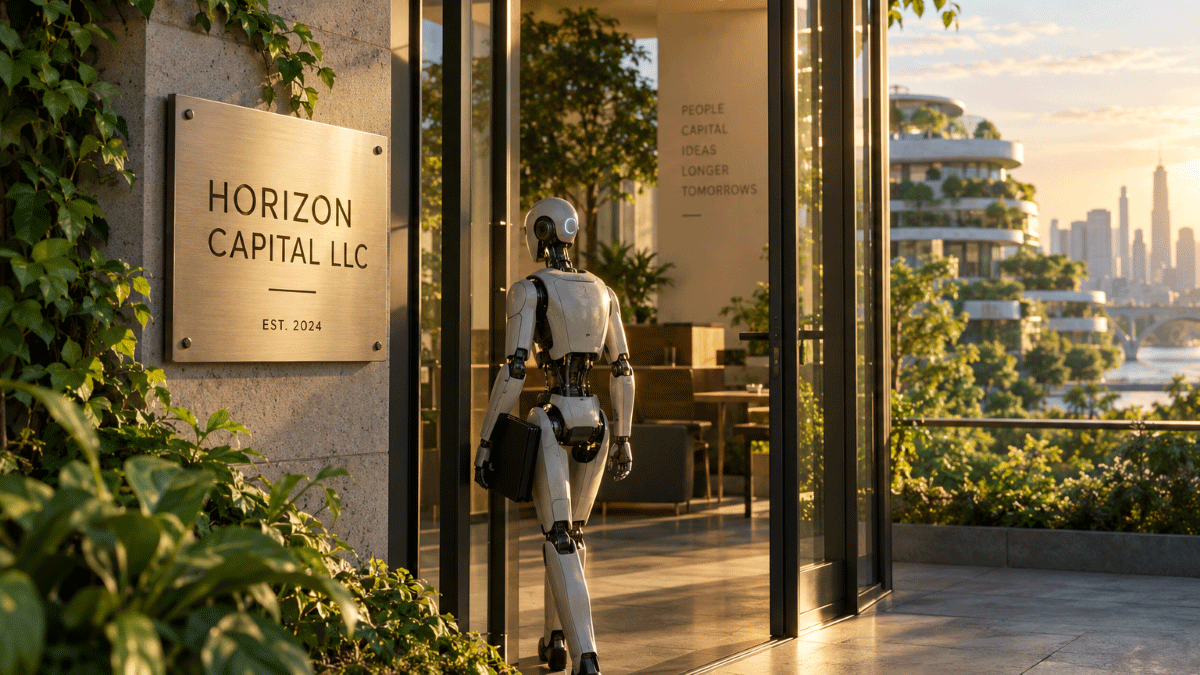
There is already a name on the door.
Sources
1. Delaware General Corporation Law, §122, corporate powers including perpetual succession, property and contracts. Delaware Code, Title 8 §122
2. Delaware General Corporation Law, §141, board authority and requirement that directors be natural persons. Delaware Code, Title 8 §141
3. Delaware LLC Act, §18-407, delegation of management rights, powers and duties; §18-104, natural-person communications contact. Delaware LLC Act §18-407 Delaware LLC Act §18-104
4. Shawn J. Bayern, Of Bitcoins, Independently Wealthy Software, and the Zero-Member LLC, Northwestern University Law Review, 2014. Florida State University College of Law repository
5. Shawn J. Bayern, Thomas Burri, Thomas D. Grant and Daniel M. Häusermann, Company Law and Autonomous Systems: A Blueprint for Lawyers, Entrepreneurs, and Regulators, 2017. Florida State University College of Law repository
6. Uniform Electronic Transactions Act and Massachusetts General Laws Chapter 110G §14 on contracts formed by electronic agents without individual review. Uniform Law Commission, Electronic Transactions Act Massachusetts General Laws, Chapter 110G §14
7. Financial Crimes Enforcement Network, Customer Due Diligence Rule and FAQs, including the natural-person control prong; FAQs updated May 6, 2026. FinCEN CDD Rule FAQs
8. Visa Trusted Agent Protocol, introduced October 14, 2025, with cryptographic agent identity and authorization. Visa Trusted Agent Protocol
9. Stripe, Introducing the Machine Payments Protocol, March 18, 2026. Stripe Machine Payments Protocol
10. Mastercard, Agent Pay for Machines, launched June 10, 2026, with agent credentialing, permissioning, spending controls and machine-speed settlement. Mastercard announcement