
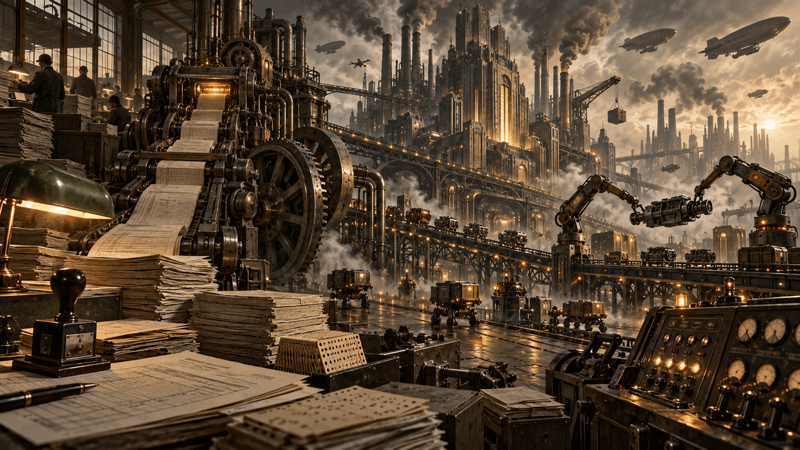
Markets can select for machine autonomy without anyone choosing machine autonomy as the goal. Nobody has to choose it A purchase order is one of the most boring documents there is. Supplier. Quantity. Price. Date.
Nobody puts one in a museum. But this might be where the handover starts.
The approval box
Oracle now sells AI agents that can run much of the procurement process. They take eligible purchase requests, create negotiations, invite suppliers, select winners, award the business and generate purchasing documents. Humans can remain at approval points. A policy determines which purchases qualify, the maximum amount and how many bids are required.
Software recommending things is not new. The important part is the approval box: who still has to click it, and what is that click worth?
Here is how the boundary moves. The agent finds suppliers faster than the team, so it gets access to more catalogs. Routine negotiations go well, so it starts those on its own. Human approval adds six hours to a $600 order, so somebody creates a limit. Under $1,000, go ahead.
A few quarters later the limit is $5,000. Then $25,000.
Humans never lost control. They wrote the policy.
The bootloader
A bootloader is the tiny program that starts a computer and loads the larger system that runs afterward. It does not need to know what that system will end up doing. Its job is to get the machine far enough along that everything else can begin.
I think boot was the second English word I ever learned, after computer.
Capitalism might be doing the same job for machine civilization. Not because capitalism wants machines. It wants the three percent.
Nobody pushes a button
In AI stories, somebody always makes the mistake. There is a room, a button, a guy with bad judgment.
Real life rarely gives us that courtesy.
One company hands procurement to software because the savings are measurable. A competitor follows because it cannot afford people to renegotiate ten thousand small contracts. A third gives its software a budget because human sign-off kills the speed it paid for.
Each decision makes sense alone.
Capitalism does not have to prefer machines over people. It only has to prefer the cheaper decision, over and over.
Pactum sells software that negotiates with suppliers. The company says Walmart achieved an average gain of 3 percent across negotiations and extended payment terms by an average of 35 days. Those are Pactum’s numbers, so they deserve the appropriate salt. The incentive is more interesting than the exact percentage. Three percent across a large purchasing budget buys a lot of automation.
The machine does not need ambition. The CFO has enough for both.
The human costs money
We say human oversight protects us. Sometimes it does.
It also costs money. People need salaries, sleep, holidays and another spreadsheet before they sign.
Some of that friction is valuable. A buyer notices that the cheap supplier breaks half the rules. An accountant spots a strange bank account. Somebody recognizes that the numbers work and the deal is still stupid.
But sometimes the human has become an expensive Are you sure? OK / Cancel box.
That creates a ratchet. Automate where mistakes are cheap. Collect evidence that it works. Push the limit higher.
Not everywhere. Not smoothly. Not forever.
Once human control has a price on a spreadsheet, though, somebody can optimize it.
From tool to customer
A calculator can beat me at arithmetic. It is still a calculator.
Give software permission to contact suppliers and it becomes a go-between. Let it accept terms and it becomes a negotiator. Give it a budget and it becomes a customer. Let it sell and it becomes a supplier.
The plumbing is being built:
Payments. Mastercard launched Agent Pay for Machines on June 10, 2026. More than 30 companies, including Stripe, Coinbase and Cloudflare, were among the first participants supporting or using it. Mastercard describes agents making continuous transactions, including payments worth fractions of a cent.
Communication. Google’s Agent2Agent protocol lets agents built on different systems communicate and delegate work. By April 2026, more than 150 organizations supported the standard, according to the Linux Foundation.
Tiny payments. Visa and Artemis examined live activity on x402, a machine-payment protocol. Their April 2026 snapshot found roughly $15 million in adjusted volume across 109.6 million transactions. Visa also reports machine-payment activity where individual payments can fall to fractions of a cent.
No consciousness is required for any of this.
A machine does not have to understand money to operate inside a budget any more than a thermostat has to understand winter to control a furnace.
Economic agency may arrive long before anyone is home inside.
How selection works
Take two companies.
Firm A makes a person approve every order.
Firm B lets software handle routine purchasing inside a budget.
Firm B becomes slightly cheaper and slightly faster. It processes the same work with fewer salaried hours.
The executives at Firm A may hate the idea. They still have to explain the extra cost.
So A copies B.
Then somebody removes another approval. Someone raises a limit. A competitor connects purchasing directly to logistics. The others respond.
Nobody needs machine autonomy as the objective. They want lower costs, faster transactions and better margins.
Autonomy is the exhaust.
The ratchet can stop
There is a serious objection.
Humans own all of this.
They own the accounts, build the data centers, manufacture the chips and pay for the electricity. Pull enough cables and machine civilization becomes a warm room full of expensive metal.
Insurers can demand human review. Regulators can impose it. Boards can decide that certain decisions are too expensive to delegate. One spectacular failure can make human oversight look cheap again.
The ratchet can stop.
It can reverse.
So no, procurement software today is not a machine civilization. Oracle explicitly builds approvals and policy limits into its system. Mastercard talks about permissions and spending controls.
The narrower claim is harder to dismiss. We are being paid to build many of the pieces a more autonomous machine economy would need: communication, delegation, payments, identity, audit trails, access to compute.
None of these systems was built to free machines. Each solves a boring business problem. That gives us something between rebellion and permanent human control.
Machines do not seize authority. We price it. Then somebody notices that a particular piece is cheaper to hand over.
Owned, but still deciding
Autonomy sounds like a switch.
Controlled or free. Tool or actor. Owned or independent.
Real systems can sit awkwardly between those categories.
A procurement agent can be fully owned and still decide how to spend $10,000. A logistics agent can choose among suppliers. A payment agent can decide when a transaction satisfies rules established hours or months earlier.
The human moves from choosing actions to choosing limits.
Someone is still at the top of the chart. There are fewer people inside it.
Strangely, this can feel like greater control. Dashboards show everything. Logs preserve every action. Spending limits are exact. The procurement agent does not accept football tickets from a supplier or approve a bad invoice because it wants to leave early.
Transactions become less human.
The organization becomes easier to measure.
When the customer is software
Markets built for humans make products that fit humans.
Pretty buttons. Checkout pages. Advertising. Customer service. Sales dinners.
A software customer has different appetites.
Structured data matters. Total delivered cost matters. Contract terms matter.
Seventeen thousand suppliers?
Buy more compute.
Once enough demand comes from software, companies gain a reason to build for software customers. Services are made for agents to discover and buy. Other agents provide specialized work. Payment systems settle the exchange. Machines become customers of businesses whose customers are machines.
Humans may still own every piece.
More of the activity happens between the pieces.
It starts as paperwork
We recognize civilizations by their monuments.
Before the monuments, they look like accounting.
The first signs of a machine economy may not be humanoid robots walking through Manhattan or an artificial intelligence requesting a seat at the United Nations. They may be transactions too small for a person to bother making.
Contracts nobody reads because machines on each side already checked them. Computing purchased by software for a task assigned by other software. Millions of decisions made after the human involvement ended, perhaps days earlier, when someone picked a limit from a drop-down menu.
This does not have to end in machine independence. But if it goes farther, it may look nothing like conquest. It may look like administration.
A procurement manager opens the policy screen. Last year’s limit was $25,000. The reports look good. Competitors are faster. She changes it to $50,000 and clicks Save.
Nothing dramatic happens. Somewhere else, a machine places an order.