
I am a science fiction writer. I have spent a good portion of my life imagining technologies that did not exist. It would be rather ridiculous of me to spend years dreaming about artificial intelligence and then, when it finally arrives, join the villagers marching towards the castle with pitchforks.
That does not mean I welcome AI without reservations. I have read enough science fiction to know better. But somewhere between the arrival of ChatGPT and the apparent death of civilization as we know it, we forgot to ask a rather important question: are we talking about writers or publishers?
Because there is a difference.
If you write a book and use AI to edit it, challenge its structure, research a historical event or point out that the character you killed in chapter three is having breakfast in chapter nine, you are a writer.
If you ask AI to produce a novel, generate a cover, write a description and then upload the whole thing to Amazon, you are running a small publishing house with a remarkably inexpensive ghostwriter. You are a businessman. Congratulations. There is nothing inherently wrong with that.
But you and the writer are not doing the same job.
Bring out the pitchforks
The literary world seems to have developed its own version of the Spanish Inquisition, only with Facebook groups, screenshots and AI detection software of questionable reliability. A book cover looks suspiciously good. A sentence contains an em dash. An author admits to having used ChatGPT during the editing process. Burn the witch!
Never mind that the author might have spent three years developing characters, building a fictional universe, researching medieval agricultural practices and arguing with imaginary people in the shower. My wife still gets that unsettling haunted look when I talk or nod to imaginary people at the table. The kids are fine. They have imaginary friends too.
The presence of AI is apparently sufficient evidence that none of this happened. I find it particularly amusing that writers, of all people, have managed to turn a punctuation mark into circumstantial evidence.
To be fair, there is a legitimate reason behind the anger. The market is being flooded with machine-generated books, and discoverability was already a nightmare before we gave computers the ability to produce mediocre fantasy trilogies before lunch.
Writers are worried about their livelihoods. Readers are worried about wasting their money. Publishers are worried about their business models. All reasonable concerns. Unfortunately, we have decided to investigate the hammer rather than the person holding it.
A brief history of literary cheating
Imagine, for a moment, that we had applied the same standards throughout the history of writing.
The typewriter would have been an unfair advantage over the poor fellow sharpening his quill. The word processor would have destroyed the authenticity of the handwritten manuscript. Spellcheck would have made dictionaries obsolete and their users morally superior.
And professional editors? Surely that is organized literary fraud.
Someone else tells you that your plot makes no sense, removes entire paragraphs, suggests better words and occasionally persuades you to rewrite the ending. Then your name, and only your name, appears on the cover.
Scandalous.
Strangely enough, I have never seen a book advertised as:
- Professional Editor-Enabled Fiction.
- Beta Reader-Assisted Novel.
- Contains 17% Contributions from the Author's Wife, Who Rightfully Pointed Out That Nobody Talks Like That.
We have always accepted that writing a book involves other people, other sources of knowledge and a variety of tools. We even encourage writers to seek feedback and professional assistance. The romantic image of the solitary genius producing a masterpiece in a candlelit room makes for a lovely painting. It makes for a considerably less accurate description of how books are produced.
The interesting question about AI is not whether it participates in the process. It is what part of the process we have delegated to it. There is a considerable difference between asking someone to read your manuscript and asking someone to write it. That difference did not suddenly disappear because the someone became a something.
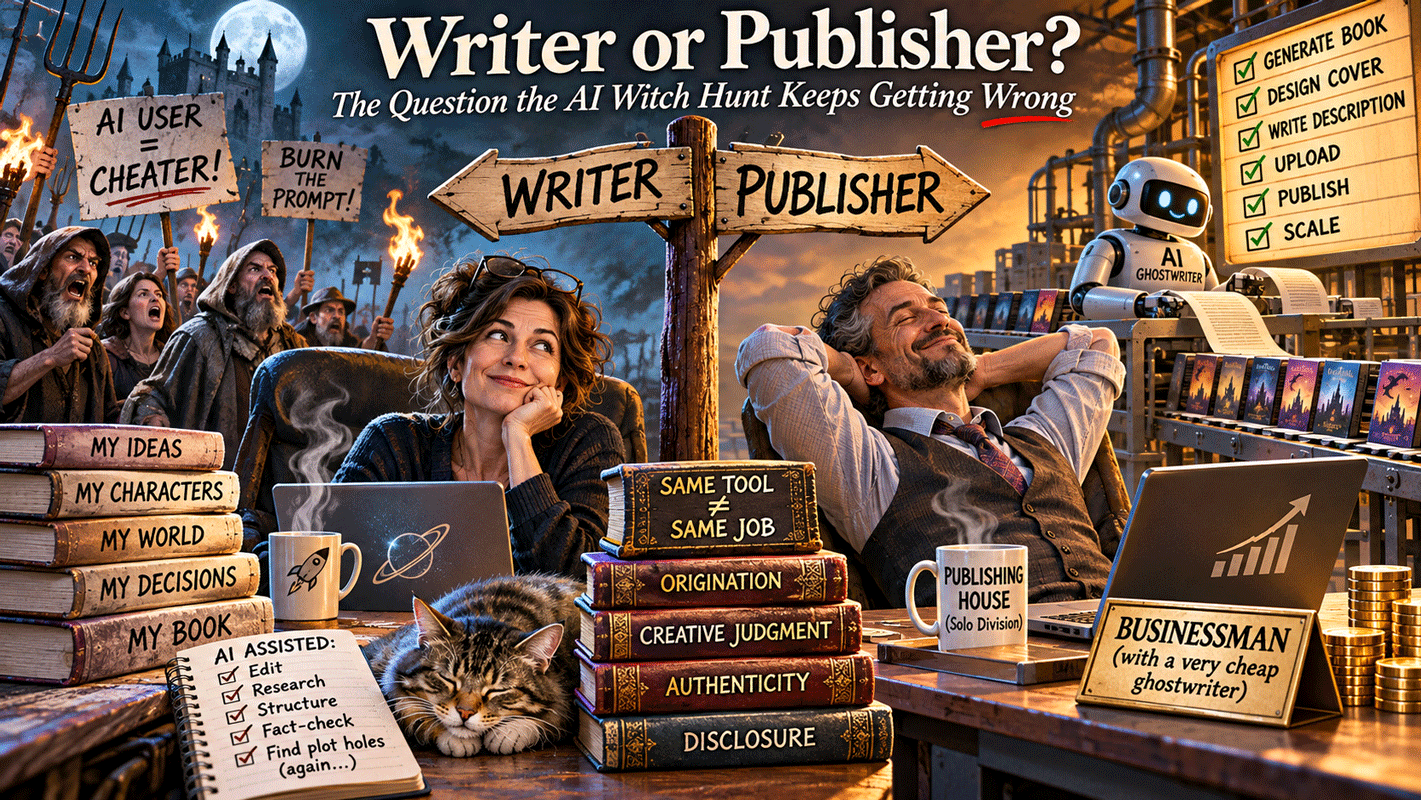
Writer, publisher or businessman?
Writing and publishing are two different professions. Self-publishing has allowed us to practice both, which might explain some of the confusion.
As a writer, I create intellectual property. I imagine worlds, develop characters, construct stories and spend an unreasonable amount of time deciding whether a particular sentence deserves to exist.
As a publisher, I turn intellectual property into a commercial product. I concern myself with editing, packaging, distribution, marketing, pricing and, occasionally, the rather exotic concept of profitability.
I can wear both hats. Many independent authors do.
Now, if I decide tomorrow to establish a publishing house that commissions novels from ten ghostwriters, I become a publisher. I do not automatically become the author of ten novels because I financed them, chose their premises and approved their covers.
Replace those ten ghostwriters with AI and the economics change considerably. My professional role does not necessarily change. I might become a very successful publisher. I might even develop an excellent instinct for what readers want and produce a commercially successful catalogue.
Good for me. But ordering dinner in a restaurant, specifying how I want my steak cooked and sending it back twice does not make me a chef.
Somewhere in the grey
Of course, reality has an annoying habit of refusing to fit into our conveniently labelled boxes.
What about a writer who develops an entire fictional universe, creates detailed character profiles, structures every chapter and asks AI to produce an initial draft?
What about someone who writes a scene, asks AI for an alternative version and then combines elements of both?
What about a Romanian writer using AI to translate a novel into English because hiring a literary translator would cost more than the novel is likely to earn?
Has the Romanian suddenly ceased to be a writer upon crossing a linguistic border?
Trying to establish authorship by counting the percentage of words generated by a machine is absurd. Words are not interchangeable units of creativity. A single sentence can be the intellectual foundation of an entire novel. Five thousand words can contribute absolutely nothing to it. I have encountered books that demonstrate the latter rather convincingly.
I would propose three questions instead:
Who originated the story?
Who exercised the creative judgment that gave the work its identity?
What would remain of the work if we removed AI from the process?
These are not questions for a courtroom or a committee of literary inquisitors. They are questions we should be capable of answering for ourselves.
If I remove AI from my writing process, I should still have my story, my characters, my universe and my creative intentions. The process might take considerably longer. The grammar might suffer. Some unfortunate reader might discover that I have used the word building eleven times on the same page.
But the book would still be recognizably mine.
If removing AI leaves me with a three-line prompt and an Amazon account, perhaps I should reconsider what I put under occupation on my tax return.
The ghostwriter in the machine
Ghostwriting is not a particularly recent invention. We have been buying books written by people whose names do not appear on their covers for generations. Somehow, civilization survived.
There is an interesting difference, though. A human ghostwriter brings experience, intellectual curiosity, judgment and, occasionally, the courage to tell a client that their idea is terrible. AI can produce a convincing simulation of some of these things. It can also agree enthusiastically with two completely contradictory statements within the space of five minutes. Anyone who has worked extensively with AI knows the peculiar experience of being congratulated for an idea, challenging it and immediately being congratulated for recognizing that it was a bad idea. A human ghostwriter can take responsibility for creative decisions. An AI cannot. It will not attend your book launch, defend a controversial passage or lose sleep over a bad review.
The responsibility for the finished product belongs to the human who decided to publish it. Which, incidentally, is one of the responsibilities of being a publisher.
The right to know versus the obligation to confess
I believe readers should know what they are buying. If I purchase a painting because I admire the work of a particular artist, I have a reasonable expectation that the artist contributed something more substantial than a credit card and a description of a sunset.
The same principle applies to books. If someone publishes AI-generated novels under a pseudonym and makes it reasonably clear what they are selling, I have no particular objection. There might be an audience for those books. Some might even be genuinely entertaining. Readers are perfectly capable of deciding what they enjoy without my permission.
But deliberately creating the impression that a human wrote a novel when the writing was outsourced to a machine is a different matter. Conversely, a writer using AI to identify inconsistencies, research a subject or improve a manuscript should not have to issue a public apology.
I would rather read a well-researched historical novel whose author used AI to help investigate nineteenth-century transportation than a historically inaccurate novel written by someone who proudly refused to use it. Ignorance does not become more authentic simply because it is human.
Interestingly, Amazon's Kindle Direct Publishing guidelines already recognize a distinction between AI-generated and AI-assisted content. Amazon requires publishers to report the former, including generated text, images and translations, but not the latter. Its rules are stricter than some might expect: substantial human editing of machine-generated material does not automatically change its classification.
That is a platform disclosure requirement, not necessarily a guarantee that the reader will be informed.
There is also the somewhat less entertaining subject of copyright. The US Copyright Office distinguishes between machine-generated material and original human expression created with the assistance of AI. Simply prompting a model does not, by itself, establish copyright over its output.
The aspiring businessman who intends to build an empire of intellectual property using AI might want to investigate how much intellectual property he will actually own. Preferably before ordering the business cards.
The unintended victims of the witch hunt
What bothers me most about the current attitude towards AI is that we might end up hurting precisely the people we claim to be protecting.
Consider an independent writer who cannot afford a developmental editor, a research assistant, a copy editor and a literary translator. These services were never equally accessible to everyone.
Having money has always provided certain advantages in publishing. We simply did not consider it necessary to print a warning on the cover of books produced by wealthy authors or well-funded publishing houses.
AI has made some forms of assistance accessible to writers who previously had to do without them. It is not a perfect substitute for professional expertise, but it can be remarkably useful. And now we are telling those writers that using the available technology might invalidate their work.
Meanwhile, the businessman producing machine-generated books at an industrial scale is unlikely to be particularly bothered by what a Facebook group thinks of his literary integrity. He has a spreadsheet. If the business model stops working, he will find another one.
The writer, on the other hand, might have invested years of their life in a single book. The accusations are considerably more personal when the product under investigation represents a part of who you are. There is something deeply ironic about a movement supposedly defending independent writers making life more difficult for independent writers.
A slightly inconvenient future
AI is not going away. We can dislike it, regulate it, criticize it and argue about its training data, its economics and its limitations. Those are important discussions in their own right. But I suspect that in twenty years, asking whether a writer used AI will sound rather like asking whether a writer used the internet.
The more interesting distinction will be between people who use technology to extend their creative capabilities and people who use technology to outsource creativity altogether. Both will exist. Both will produce books. Both will compete for the attention of readers.
Perhaps we will eventually develop separate markets for human-written fiction, AI-generated fiction and everything in between. Perhaps the provenance of a manuscript will become a valuable commercial asset. Perhaps readers will pay a premium for the opportunity to read something imagined and written by another human being.
As a science fiction writer, I find all these possibilities considerably more interesting than counting em dashes.
So, are you a writer or a publisher?
There is nothing inferior about being a publisher. Publishing is a difficult business, and the world needs good publishers just as much as it needs good writers. There is nothing particularly noble about refusing to use modern technology, either. Bad literature existed long before computers, and humanity has demonstrated an impressive ability to produce it without assistance. What matters is whether we are being truthful about what we create and what we sell.
The question should not be: Did you use AI?
It should be: Who did the work that the reader reasonably assumes the author did?
I want to use AI to become a better writer, not to avoid being one. The distinction is important to me because imagining stories, developing characters and finding the right words are precisely the reasons I became a writer in the first place.
Why would I outsource the part I enjoy?
The paperwork, marketing, formatting, accounting and endless administrative nonsense associated with publishing a book? Dear artificial intelligence, we need to talk.
P.S. In the interest of transparency, I brought a draft of this article to an AI and asked it to make it wittier. The argument is mine. The responsibility for publishing it is also mine. Feel free to disagree with either the argument or the jokes.
The pitchforks are optional.