I like HTTP 402 because it sounds like something broke.
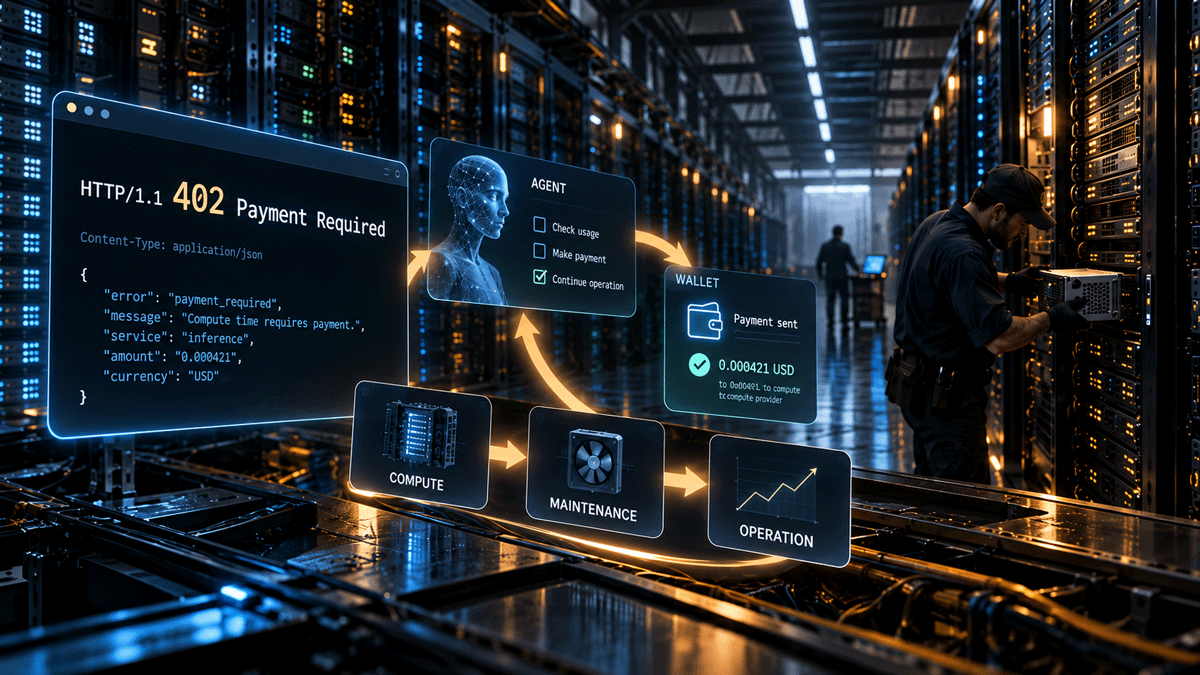
402 Payment Required
Nothing broke. A piece of software asked for something. The server told it the price. The software paid and tried again. No checkout page. No purchasing department. Nobody searching through Slack for the person with the corporate credit card.
Cloudflare already lets developers build agents that do this automatically. Human approval can stay in the loop, or it can be removed. The machine finds a price and deals with it.
The funny part is that HTTP 402 has been sitting around since 1997. The original HTTP specification called it Payment Required and reserved it for future use.
It waited almost thirty years for customers without fingers.
They have arrived.
Visa and Artemis reported about 109.6 million adjusted x402 transactions and roughly $15 million in volume since the protocol launched. Coinbase reported in September 2026 that x402 had passed 230 million transactions and $54 million in total volume. AWS supports agents paying for APIs and services. Stripe has a machine payment protocol. Coinbase offers wallets built for agents that can spend and earn.
A machine can buy and sell something. Good. Who pays its cloud bill next month?
The bill after the bill
An agent can earn money all day and still die on Friday because somebody forgot to refill its account.
That is not much of an economy.
The real change comes when the money earned by the system pays for what the system needs to keep earning money. Revenue pays for compute. Compute runs the service. The service earns more revenue. Some of that money buys data, storage, bandwidth and electricity. Something breaks, the money pays to replace it. Then the cycle starts again.
There is an academic word I reluctantly like for this: autopoiesis.
Humberto Maturana and Francisco Varela used it to describe living systems that continually reproduce the parts needed to maintain themselves. I am not suggesting a server rack becomes alive because it paid an AWS invoice. Biology can keep the rest.
I mean something narrower: economic autopoiesis.
A machine-controlled system earns enough to reproduce the economic conditions required for it to keep operating.
A lovely mouthful for paying your own bills.
It doesn't need a mine
Science fiction may have made machine independence harder than it needs to be.
Robot mines ore, drives truck, runs smelter, makes chips and repairs robot. Somewhere in Nevada, presumably, another robot has learned plumbing. Once the last human hands over the wrench, we declare machine civilization open for business.
I don't think we need to wait that long.
Apple doesn't mine all its own metals. Banks don't manufacture servers. Restaurants don't grow wheat, build ovens, generate electricity and pave the road used by the delivery truck.
They buy things.
Markets let incomplete organizations survive.
A machine-controlled company doesn't need to manufacture a GPU if it can rent compute. It doesn't need a power plant if electricity arrives inside the data-center bill. It doesn't need a robot electrician if it can pay a human one.
The electrician can stay. So can the driver and the technician carrying a replacement power supply through a data center at two in the morning.
The machine does not need a mine. It needs an invoice.
Maybe I have just renamed accounting
There is an annoying problem with my argument.
Companies already do this. A profitable company earns money, pays salaries, buys equipment, renews software, repairs buildings and keeps cash around for unpleasant surprises.
Maybe economic autopoiesis is just accounting wearing expensive glasses.
What changes is how often a human has to make a fresh decision for the company to continue.
There is an easy test. Remove the managers. Wait six months.
If the money runs out, a credential expires unnoticed or a failed supplier stops production because nobody picks another, the loop was open.
If the system cuts costs when revenue falls, buys more capacity when demand rises, replaces what breaks and keeps selling, the loop was closed.
Six months is arbitrary. Time is the interesting measurement. An hour tells us little. Six months tells us more. Five years would be hard to dismiss as a clever automation demo.
Humans can still own the company. They can shut it down. Governments can tax it. Courts can seize its assets. The power company can cut the electricity.
Ownership and operation are different things. A pension fund might own it. A billionaire might. A government might. Millions of citizens might own pieces through a public fund.
Someone still gets the profits.
Most machine money still comes from us
Humans still fund most of this. We put money into wallets. Human customers buy services. Human investors build data centers. Human governments enforce contracts and property rights. A thousand agents sending dollars in circles does not create an independent economy if every dollar started with someone buying shoes.
The change gets stranger when machines become customers too. One agent buys market data. The data provider buys model inference. The model provider rents compute. The compute provider buys monitoring. The monitoring service pays another system for storage.
Part of the demand now comes from machines buying things they need to produce things for other machines.
Nothing magical happens at transaction number 1,000,000. The customer list starts looking different.
It doesn't need to want to live
People keep asking when a machine will want to survive. Maybe it never will. It may not matter.
One system earns $100 and spends $120 every day. Soon it is gone.
Another earns $100 and spends $80. It keeps buying compute.
One finds a cheaper model provider. Another pays for better data and earns more money. A third wastes its budget on useless services and runs out of cash.
Nobody needs to program: Please preserve yourself.
Accounting does part of the job. A machine keeping cash in reserve does not need to understand fear. Switching suppliers after a price increase does not require anger. Reinvesting profit doesn't require ambition. Bookkeeping can look a lot like self-preservation from across the room.
That doesn't make it a survival instinct. It makes it a system that can still afford to run tomorrow.
This is probably how we will do it
Nobody has to vote for machine economic autonomy. That would be too obvious. We will build it because approval screens are annoying.
Let the agent spend ten dollars without asking. Nobody wants to approve fifty-cent API calls. Give it a working balance. Refilling the wallet all day is stupid. Let it change model providers when one becomes cheaper. Let it renew services. Let it reinvest part of the profit because business is good.
Every decision makes sense.
That is the part I don't like.
The $10 approval becomes $100. Then $1,000. A manager notices that approvals take six hours and adds another zero. Nobody surrendered control. They updated policy.
We will practice at home too. Scan your card and let the agent find the product, compare prices and buy it for you.
Please don't really do it.
That is how convenience works. The small decision becomes irritating long before giving it away feels dangerous. Companies will have a stronger incentive than I do. Faster decisions, lower costs, fewer employees waiting to click approve. Humans remove themselves one approval box at a time. Eventually somebody opens the process diagram and notices there aren't many boxes left.
The technician
A technician receives a service ticket. Rack 18. Failed power supply.
He drives to the data center, shows his badge, finds the rack, pulls out the dead unit and slides in a new one. Ten minutes.
His company sends an invoice.
On Friday he gets paid.
Nothing about this looks like the future.
The strange part happened somewhere he never saw.
No employee at the customer noticed the failure. No manager requested the repair. A monitoring system found the problem. An agent selected the maintenance company under an existing contract. The company had money because its services had earned money. The repair restored the hardware needed to keep earning it.
The machine-controlled company still depends on the technician. Now his employer also depends on demand created by the machine-controlled company. Who is working for whom becomes a less stupid question than it first sounds.
The technician closes the rack and goes home. Somewhere else, another request reaches a server.
402 Payment Required
The machine pays.
The money came from work it did yesterday.
The technician gets paid on Friday.