
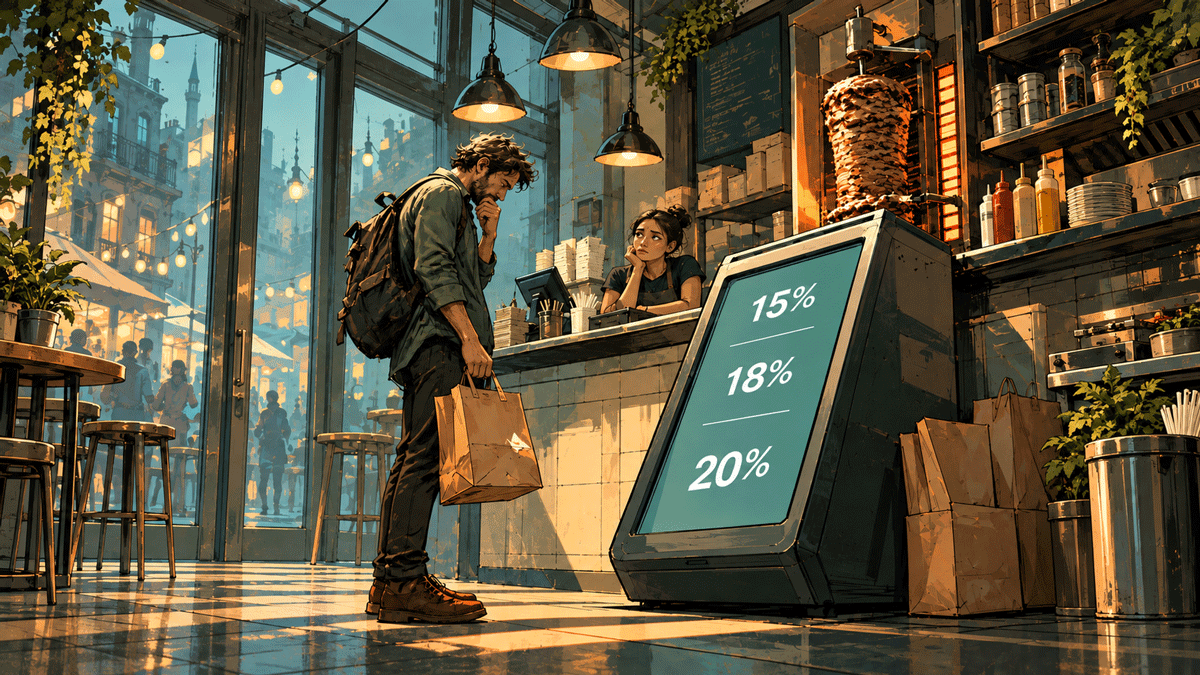
How a payment screen turned generosity into an obligation, and why I refuse to call it normal.
I like shawarma. Perhaps a little too much. And when I'm buying dinner for the family, I usually order enough to make the bill substantial. Nothing extravagant, just a good meal that everybody will enjoy.
I order online, get into my car, drive to the restaurant, find somewhere to park, and walk in to collect the food. A perfectly ordinary transaction, or so I think.
Then comes the moment I've learned to dread. The employee turns the payment terminal toward me, and there they are, those three cheerful little invitations to prove I'm a decent human being.
15%. 18%. 20%.
I look at the screen. Then at the bag. Then back at the screen.
Twenty percent of what, exactly?
On a $100 family order, that's another $20. For picking up my own dinner. Apparently, the act of handing me a paper bag has become a premium service, and I'm expected to acknowledge it financially.
I usually press "No tip." Sometimes I press it with more determination than the situation deserves. Other times I'm distracted, tap through the options, and realize only afterward that I've paid extra for something I never intended to reward.
It's not the twenty dollars alone that bothers me, although I can think of better uses for twenty dollars. It's the expectation. That quiet, persistent suggestion that paying the agreed price is somehow insufficient.
Perhaps it bothers me more because I grew up in Europe, where tipping was something you did to thank a person, not something a machine asked you to justify refusing. You left a little extra when someone had been particularly helpful, attentive, or kind. Sometimes you left nothing. Nobody interpreted that as a declaration of moral bankruptcy.
A tip was a gesture of appreciation. It came after the service, not before you'd even had a chance to enjoy what you were paying for. I still believe in that kind of tipping. I've left generous tips when I felt someone deserved them, and I've never regretted doing so. What I resent is having that small, human gesture converted into a percentage, programmed into a machine, and presented as an expectation.
Somewhere along the way, we lost that simplicity. And the scary thing? We've decided this is normal.
I call it the shawarma tax.
Not because it's a real tax. Real taxes, whatever we think of them, have at least the courtesy of being established through legislation. This one has been introduced by a payment terminal and enforced by the peculiar human discomfort of appearing ungenerous.
And I am angry about it.
Not the sort of anger that requires raising one's voice. The more persistent kind, the kind that comes from watching something unreasonable become so ordinary that nobody bothers questioning it anymore.
I refuse to let that happen.
The wrong person is being asked to pay
Before going further, I want to make something clear: I'm not angry at the young employee behind the counter. He didn't design the terminal, decide which percentages to display, or invent the expectation that every exchange of money should end with a small examination of the customer's conscience.
He is simply standing there, caught in the middle.
If I decline, he may feel rejected. If I accept, I may feel manipulated. Neither of us created the situation, yet both of us are expected to participate in it.
It's a remarkable arrangement. The employer and the payment system establish the conditions, while the employee and the customer are left to manage the awkwardness.
The first has to appear deserving. The second has to appear generous.
And we're supposed to call this customer service.
A business has expenses. Rent, electricity, ingredients, equipment, insurance, and, rather importantly, wages. These are not unexpected complications that materialize after I have placed my order. They are the costs of operating a business.
They belong in the advertised price.
If paying employees properly means a shawarma must cost $12 instead of $10, charge me $12. I'll decide whether it's worth buying. What I object to is being shown one price and then encouraged to add another 20 percent because the business has discovered a more convenient way to approach the subject of compensation.
We have somehow turned the customer's goodwill into part of the business model, without the inconvenience of including it in the price.
Quite an innovation!
The screen knows exactly what it's doing
Or, more accurately, the people designing these systems know that the way a choice is presented influences the decision.
We have decades of behavioural research explaining this. People don't make every financial decision by carefully examining all available options. We respond to defaults, suggestions, timing, convenience, and social expectations.
A 2014 study by Kareem Haggag and Giovanni Paci examined more than 13 million New York City taxi rides. It found that suggested tip amounts on payment screens had a substantial effect on what passengers left. Set the suggestions higher, and average tips could increase. Push too far, and more customers left no credit-card tip at all.
The buttons matter.
That makes the familiar payment screen rather more interesting than it first appears.
Why those percentages? Why that order? Why ask before the payment is complete? Why present the decision while an employee is standing in front of the customer and other people may be waiting?
Some of this is simply convenient software design. Some is the predictable effect of social pressure. Whatever the intention, the outcome is that a supposedly voluntary choice is presented in a way that can make refusal uncomfortable.
Even the payment companies have an economic interest in the amount being processed. Square, for example, confirms that its processing fees apply to the total transaction, including tips. A larger card transaction generally produces a larger percentage-based processing fee.
That doesn't prove the company deliberately designs its tipping interface to maximize those fees. But it raises a perfectly reasonable question about incentives.
When the company providing the technology can earn more from a larger transaction, should we be surprised that the technology has become so enthusiastic about asking for one?
And then comes the inevitable defence.
"You can always press No tip."
Of course I can. If I can’t find the button. Lately I have to lcik on “another %” and type 0.
I can also refuse a door-to-door salesman, decline an unsolicited donation, and tell someone calling during dinner that I'm not interested in changing my telephone provider.
The existence of an exit doesn't make the interruption welcome.
The issue isn't whether I am physically capable of pressing a button.
It's why buying lunch now requires me to formally decline an invitation to demonstrate my generosity.
A tip used to be something I offered. Now it's something I must refuse.
The convenient fiction of rewarding good service
We're told that tipping rewards good service. It's a pleasant explanation. It suggests fairness, merit, and a direct relationship between effort and compensation.
Unfortunately, reality is less cooperative. Michael Lynn, a Cornell researcher who has spent decades studying tipping, has found that customers' ratings of service quality explain only about 4 percent of the variation in restaurant tip percentages.
Four percent.
Service matters, but considerably less than the comforting story suggests. Other factors, including social expectations, payment methods, group dynamics, and personal characteristics, can influence what customers leave. And because people are people and are subjective in any type of judgment, we have a compensation mechanism that supposedly rewards professional performance but can also reflect prejudice and social convention. This is a strange foundation on which to build someone's livelihood.
At a pickup counter, what exactly am I being asked to reward? The efficiency of the paper bag? The elegance with which the payment terminal was rotated toward me?
There is nothing wrong with appreciating the people who prepare our food. Their work deserves respect and proper compensation. But there is a distinction between paying for the work involved in delivering a product and voluntarily recognizing exceptional personal service.
If we erase that distinction, tipping stops meaning anything. It becomes an automatic surcharge with better public relations.
The customer is tired. The worker is worried. The system continues.
The Canadian numbers suggest that patience is wearing thin.
A March 2026 H&R Block Canada survey found that 67 percent of respondents believed tipping culture should be abolished. Ninety-three percent were annoyed by tipping prompts in situations where gratuities had not traditionally been expected.
More interestingly, 41 percent said they had avoided businesses known for aggressive tipping prompts. That's not simply a collection of customers who dislike paying more. It's evidence that the experience itself is beginning to affect where people choose to spend their money.
But the other side of the counter isn't celebrating either.
A 2026 survey ommissioned by Actual, a tip-pooling and payout company, which drew on 506 hospitality workers, and conducted for by Angus Reid found that 67 percent of surveyed tipped workers reported declining tip income over the previous two years. In Ontario, the figure reached 72 percent.
Forty-three percent said they depended on tips to cover essential expenses.
Those figures don't prove that payment prompts caused the decline. They do demonstrate something worth considering: the growing pressure on customers has not eliminated workers' financial insecurity. We have created a system in which customers resent being asked to give more, while employees worry about receiving less.
Both sides are frustrated, and neither controls the rules.
Ontario eliminated its lower minimum wage for liquor servers in January 2022, bringing them under the general minimum-wage rate. That was an important change, but it didn't remove tipping expectations. Of course, minimum wage is not necessarily a living wage. And many workers legitimately earn considerably more through tips than they would through a fixed hourly rate.
That matters. Eliminating tipping overnight without replacing the income could hurt the very people a reform is supposed to help.
But acknowledging that reality shouldn't end the conversation.
It should lead us to ask why we have allowed so many workers to depend on the generosity of strangers for their ordinary financial security.
A wage should be a responsibility. A tip should be a possibility. We have gradually reversed the relationship.
Twenty percent is not a fracking rounding error
There's another argument I hear regularly.
"If you can afford to spend $100 on food, surely you can afford another $20."
I find this reasoning fascinating. Apparently, once I have demonstrated the financial capacity to purchase something, that becomes evidence that I should be willing to pay more for it.
Try applying that logic anywhere else.
You buy a $1,000 television, and at checkout the terminal asks whether you'd like to add another $200 in appreciation of the employee who handed you the box.
You purchase groceries for $200, and the supermarket suggests another $40 because stocking shelves is hard work. It is hard work. That's why the supermarket employs people to do it.
Imagine a mechanic finishing a $2,000 repair and presenting three buttons requesting an additional $300, $360, or $400 to acknowledge the quality of the work.
We would rightly ask whether the original price was serious.
Yet with food, we have somehow accepted that the more expensive the order, the greater the expected expression of gratitude.
Why?
Does placing five shawarmas into bags instead of two create an obligation worth $20? Perhaps the bag was particularly elegant.
And the problem isn't limited to a single meal. It's the accumulation.
The coffee shop. The bakery. The sandwich counter. The takeaway restaurant. Another screen. Another suggestion. Another small decision about whether to surrender a little more money than the price originally indicated.
A few dollars here, twenty dollars there.
Each transaction is presented as insignificant. Together, they become an expensive habit that nobody explicitly agreed to.
The percentages have also quietly normalized a rather extraordinary assumption: that the appropriate value of a thank you should rise automatically with the price of the product.
Twenty percent.
A fifth of the bill. Not a rounding error, not a token of appreciation, but a substantial addition to the agreed price.
Generosity should not be measured by how successfully a payment terminal can exploit my reluctance to disappoint a stranger.
We can do better without making anyone poorer
I don't want tipping abolished by decree tomorrow morning. I don't want restaurant workers losing income. I don't want small businesses closing because they're suddenly expected to absorb costs they cannot manage. And I certainly don't want to replace one poorly designed system with another simply because it sounds fairer on paper.
Restaurants operate on difficult margins. Businesses that eliminate tips and raise menu prices can find themselves at a disadvantage against competitors advertising lower prices while relying on gratuities.
Toronto's Beast Pizza tried moving to a no-tipping model with higher wages, then returned to pooled tips after the economics became unsustainable.
This is precisely why reform cannot depend entirely on individual businesses acting alone. If transparent pricing is commercially punished, we need common standards.
Fortunately, some solutions aren't particularly mysterious.
Start with the transaction itself.
If I order online and pick up my own food, the default expectation should be simple: I pay the price displayed. No automated solicitation. If I want to leave something extra, let me initiate it.
If I receive meaningful personal service, a voluntary tipping option is reasonable, but the choice should be neutral and private, without preselected amounts or visual tricks that favour the larger percentage.
Quebec has already taken a useful step. Since May 2025, suggested tips must be calculated on the pre-tax amount and displayed neutrally, with the available options presented uniformly. Apparently, technology can accommodate consumer dignity when the law insists on it.
Then address the wages.
Move toward compensation that gives employees financial stability without making them dependent on a customer's mood at the payment terminal. Do it gradually, with realistic support for smaller businesses and attention to workers who would otherwise lose income.
Make tip distribution transparent.
If I'm asked to give extra money, I should know whether it goes to the employee I interacted with or is shared among the team. Ontario already restricts employers from retaining workers' tips except in legally permitted circumstances. Transparency should be just as ordinary as compliance.
And perhaps most importantly, stop treating a refusal to tip as a character defect. A customer who pays the advertised price has fulfilled their obligation. They have not stolen from the employee, insulted the restaurant, or failed some essential test of citizenship.
They have completed a purchase. That used to be enough.
I want my thank-you back
I still tip.
When somebody makes an evening better, solves a problem, offers thoughtful service, or goes beyond what was reasonably expected, I appreciate it. Sometimes with words. Sometimes with money. Often with both.
I don't want to lose that human exchange.
What I object to is the systematic conversion of appreciation into expectation.
Technology was supposed to make ordinary transactions simpler. Instead, we've designed systems that insert an additional negotiation into the final seconds of a purchase.
Businesses get an opportunity to encourage higher compensation without necessarily changing the advertised price. Payment providers process the additional money. Workers are placed in the uncomfortable position of depending on a decision they didn't ask to supervise. And customers are left staring at a screen, wondering when refusing to pay an extra 20 percent became something requiring an explanation.
The absurdity is almost elegant.
I came to buy dinner for my family. Somehow, before being allowed to leave, I have been invited to participate in an assessment of my moral character.
I would have preferred the garlic sauce.
There is a larger issue here, and it extends well beyond restaurants.
When technology makes it easy to turn social expectations into predictable revenue, somebody will eventually try. The mechanism doesn't require cruelty or even particularly bad intentions. It only requires a system that benefits from human discomfort and enough repetition for that discomfort to become normal.
That is what bothers me most. It's the quiet assumption that my generosity is now something a business can request, calculate, and build into the ordinary act of buying food.
No.
Pay your employees properly. Tell me what your product costs. Let me decide whether I want to buy it. And if someone makes my day a little better, let me thank them without first consulting a machine.
I intend to stay angry about this.
Not because a shawarma is worth starting a revolution over, but because small indignities have a way of becoming permanent when everyone decides they're too small to challenge.
Put the cost of the shawarma in the price of the shawarma.
Keep the tip for the moments when it actually means thank you.
And please, let me collect my dinner without making an appointment with my conscience.
Sources and notes
- Haggag, Kareem & Giovanni Paci (2014). "Default Tips." American Economic Journal: Applied Economics, 6(3), 1–19. Analysis of over 13 million NYC taxi rides showing how suggested tip amounts influence behaviour. https://www.aeaweb.org/articles?id=10.1257/app.6.3.1
- Cornell Chronicle (March 2026). "Why we tip, who we tip and what it really says about us." Michael Lynn's research, including the finding that service evaluations explain approximately 4% of variation in restaurant tip percentages. https://news.cornell.edu/stories/2026/03/why-we-tip-who-we-tip-and-what-it-really-says-about-us
- Lynn et al. (2008). "Consumer Racial Discrimination in Tipping: A Replication and Extension." Journal of Applied Social Psychology, 38(4), 1045–1060. https://ecommons.cornell.edu/entities/publication/84c39daf-0ec4-4eac-a52b-9143449d794b
- H&R Block Canada (March 2026). "Two-Thirds of Canadians (67%) Say It's Time to Abolish Tips." Survey findings on tipping fatigue and avoidance of businesses using aggressive prompts. https://www.hrblock.ca/blog/two-thirds-of-canadians-67-say-it-s-time-to-abolish-tips-reveals-new-h-and-r-block-canada-study
- Actual / Angus Reid (September 2026). "Tipping in Canada 2026: What Hospitality Workers Actually Told Us." Survey of 506 Canadian hospitality workers, including 250 respondents receiving tips. https://onactual.com/blog/tipping-trends-in-canada-2026-what-hospitality-workers-actually-told-us
- Ontario Government. Employment Standards Act Policy and Interpretation Manual. Elimination of the lower liquor-server minimum wage effective January 1, 2022. https://www.ontario.ca/document/employment-standard-act-policy-and-interpretation-manual/part-ix-minimum-wage
- Square Canada. "Learn about Square fees." Confirmation that payment-processing fees apply to the transaction amount, including taxes and tips. https://api.squareup.com/help/ca/en/article/5068-what-are-square-s-fees
- C.D. Howe Institute (July 2026). "Beyond the Terminal: A Policy Agenda for Canadian Tipping Culture." Analysis of tipping reform, consumer behaviour, restaurant economics, and the Beast Pizza example. https://cdhowe.org/publication/what-to-do-about-the-proliferation-of-tipping/
- Office de la protection du consommateur, Québec (May 2025). "Des pourboires calculés avant les taxes." New rules for calculating suggested tips before tax and presenting options neutrally. https://www.opc.gouv.qc.ca/actualite/communiques/article/pourboires-avant-taxes-et-prix-plus-clairs
- Ontario Ministry of Labour. "Tips or Other Gratuities." Rules governing employer retention of tips, employee entitlements, and tip pooling. https://www.ontario.ca/document/your-guide-employment-standards-act-0/tips-or-other-gratuities