
My time-management skills need improvement. The problem is that you can become more efficient only up to a point. After that, you have to dislocate time from something else. Hint: fasting saves you about two hours a day.
My go-to stress-release activity is gaming. I do not have much time left for it, and my game queue is now so long that I am still playing Uncharted. Or perhaps the queue is not the real problem. Maybe my choice of games follows the same pattern as the professional, personal and start-up parts of my life, those parts that operate permanently on the “I want to disrupt the planet” wavelength.
Maybe I am not looking for another game. Maybe I am looking for the next disruption. So I went looking for the last one — the moment gaming actually changed something about being human — to see if I could recognize the next one when it arrives.
Some revolutions arrive dressed as revolutions.
They have manifestos, political movements, crowds in the streets and old institutions collapsing on live television.
Others arrive dressed as toys.
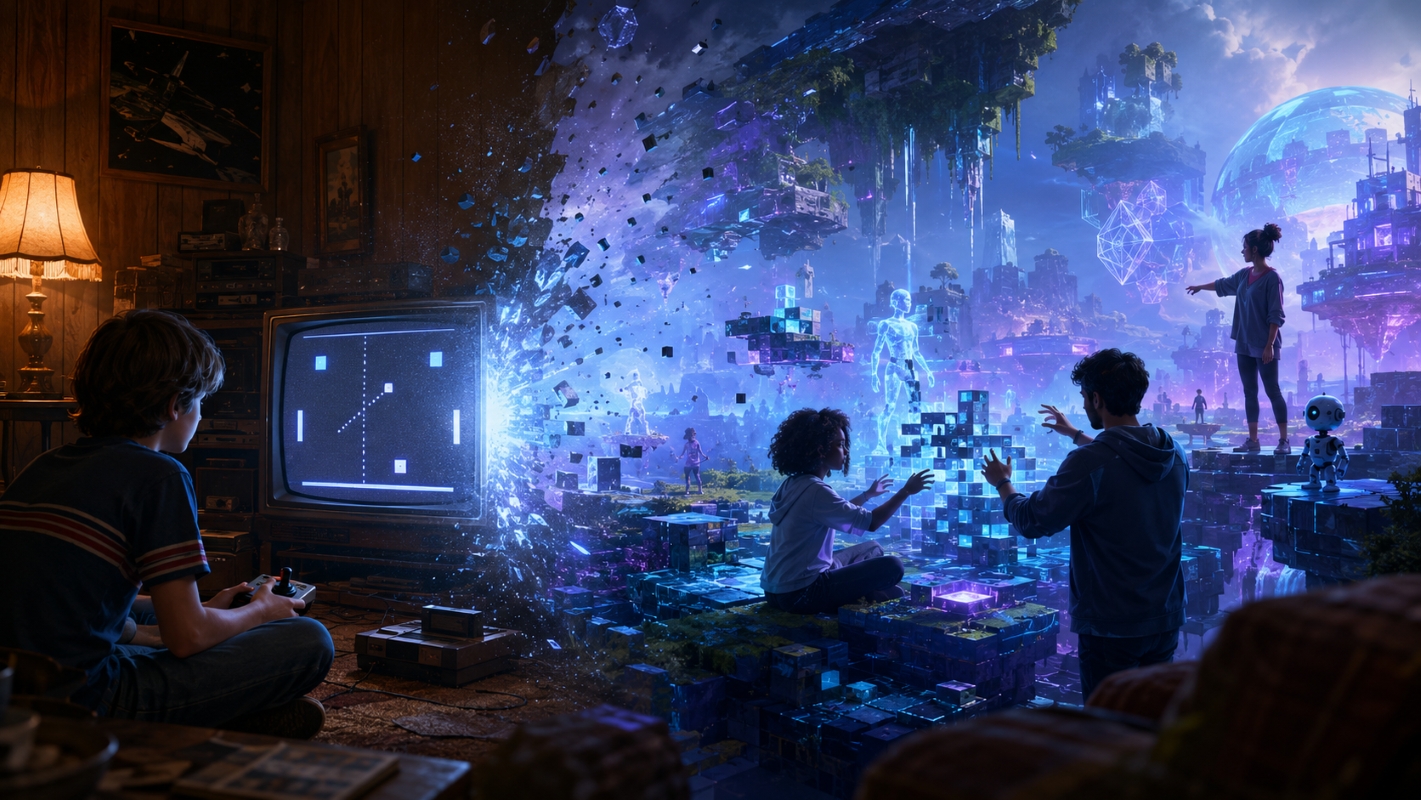
A small box connected to the family television. Two wired controllers. A few white shapes moving across a black screen.
Nothing that looked capable of changing humanity.
The Magnavox Odyssey, released in 1972, was the first commercial home video game console. Pong brought the idea to a much larger audience. Atari later popularized the cartridge-based console, allowing one machine to run an expanding library of games. After the industry collapsed under poor-quality products and oversupply in the early 1980s, the Nintendo Entertainment System helped bring it back into people’s homes.
This is the familiar history. But it does not explain what really happened. The first consoles did not simply disrupt toys, arcades or television programming. They disrupted the relationship between a human being and a machine.
The screen answered back
Before the console, the TV spoke and you listened. Someone else selected the program. Someone else determined the schedule. Someone else wrote the story, performed it, edited it and decided when you were allowed to see it.
You could change the channel. That was the extent of your power. I know. I was there. In the old days, I was the remote control. My father would issue a vocal command from the sofa, and I would get up and change the channel.
Then someone connected a strange box to the television and placed a controller in your hand. You pressed a button. Something on the screen moved. It moved because of you.
This seems painfully ordinary today. We touch screens, move cursors, speak to devices and expect software to react before we finish thinking about what we want.
In 1972, it was not ordinary. Also, I wasn’t even born yet.
The dominant screen in the home stopped being something that spoke at you and became something that responded to you. The audience became a participant. Maybe that was the real beginning of personal computing and not the moment when computers became small enough to enter the home, but the moment people understood that they could have a conversation with a machine without knowing anything about computers.
You did not need to understand processors. You did not need to write code. You moved the controller and the machine answered.
We learned more from the joystick than we realized
The joystick looked simple. Move left. Move right. Press the button. But it quietly taught millions of people a new way of thinking. Your actions produced immediate feedback.
The system had rules, but those rules could be discovered. Failure was not necessarily permanent. You could lose, restart and try something different. You could become better through repetition instead of explanation.
The machine did not need to give you an instruction manual for every possibility. You acted, observed and adapted.
Click. Observe. Fail. Retry. Learn.
This is now how we use almost every digital product. It is how we learned graphical interfaces, websites, smartphones and applications. When something unfamiliar appears on the screen, we press it to see what happens. The console made experimentation with a machine feel safe. It also created a new relationship with failure. In real life, failure can cost money, time, reputation, employment or something more important: your life.
In a game, failure became frequent, reversible and informative. Sometimes it even became enjoyable. People willingly repeated difficult actions hundreds of times because the challenge was clear, the feedback was immediate and progress was visible. Years before companies started placing progress bars, streaks, badges and artificial rewards inside every product imaginable, games had already discovered something important about human nature:
We do not hate difficult work. We hate difficult work that gives us no sense of progress.
Then the toy became a platform
The cartridge transformed the console again. The machine was no longer a finished appliance with one purpose. It became a platform capable of receiving new experiences.
Buy the hardware once. Add software later. Build a library. Invite developers. Attract more players. Use the growing player base to attract more developers.
The circle becomes a business model.
Much of the modern digital economy follows a version of this architecture:
Hardware. Platform. Developers. Software. Users. Network effects.
The App Store did not invent it. Steam did not invent it.
The first consoles were already teaching us that the most valuable position was not necessarily creating one experience. It was controlling the environment through which many experiences reached people.
That created enormous possibilities. It also created the cage. The platform owner stood between the creator and the player. It controlled distribution and decided what could be published. It controlled compatibility, discovery and access.
Games purchased for one machine could not travel to another. Communities grew inside separate ecosystems. A player’s history remained attached to accounts controlled by companies. The person was continuous. The digital identity was not.
The early console market also delivered a warning we seem determined to relearn with every new technology. By 1983, poor quality and oversupply had helped crash the American video game market. More products did not create more value. They damaged trust in the entire category.
Production had become easier. Distribution had expanded. Quality, trust and discovery had not kept pace. History repeating? Keep that thought somewhere close when somebody promises that generative AI will save creative industries by allowing us to produce unlimited amounts of content.
Gaming did not remain entertainment
The little box under the television grew up. Games became stories, economies, meeting places, competitions, professions and persistent social environments. They gave us avatars before social media asked us to create profiles. They gave us usernames and pseudonyms. They gave us digital possessions, status, achievement, reputation and alternate identities. They taught children that identity could be constructed inside a digital world long before adults started worrying about what social networks were doing to them.
Gaming is now part of society’s infrastructure. More than 205 million people in the United States played video games according to the Entertainment Software Association’s 2025 study, and 89% of players had played online.
People meet their friends inside games. Couples meet inside games. I know quite a few and was invited to the weddings. Families separated by thousands of kilometers spend time together inside games. People attend concerts, build communities, watch competitions, create businesses and sometimes earn their living through gaming.
The game is no longer always the activity. Sometimes the game is the place where the activity happens.
But gaming also helped industrialize attention. Progress systems became retention systems. Rewards became daily obligations. Scarcity became artificial. And wherever digital status acquired value, a shadow economy followed. Rare items, in-game currency and entire player accounts began changing hands outside the platforms that created them, turning fictional possessions into a real multimillion-dollar market.
The joyful desire to play became a metric to optimize. The same methods escaped gaming and entered social media, education, fitness, shopping and work software. Everything became a game except, strangely, the parts that were supposed to remain fun.
The console revolution gave us interactive empowerment. It also gave corporations better instruments for behavioral control. The individual users lost part of their identity in the process.
The current problem is not access
The gaming industry does not suffer from a shortage of games. It does not suffer from a shortage of platforms, controllers, stores, or subscriptions.
The global games market exceeded $200 billion in revenue in 2025. Yet 64% of PC playtime still went to games released before 2019. There is more available content than any human being could experience in several lifetimes. Still, much of our time remains concentrated in familiar games and established ecosystems.
Why? Because content is abundant. Attention, trust, friendship, continuity are not.
Starting a new game often means learning another system, creating another account, convincing friends to purchase it, downloading another enormous installation and abandoning the history accumulated somewhere else.
The market solved access to content and then created a dozen new forms of friction around it. A player may have one identity on Steam, another on Xbox, another on PlayStation, Nintendo, Roblox, Discord and every individual game that decided it needed its own account. Each platform knows a fragment of the person and OWNS that fragment.
Friends do not always travel between platforms. We accepted this because there was no alternative. That is usually the sentence spoken immediately before an industry changes.
Better graphics will not be the next revolution
I started thinking about what could have an effect comparable to the first home consoles. Not what could become a successful product. Not what could produce another profitable gaming company.
What could change our relationship with machines again?
Better graphics will not do it. Larger worlds will not do it.
Cloud gaming improves access to hardware but does not fundamentally change the player’s agency. Virtual reality changes presence and may eventually become much more important, but entering a designed world is still entering a world whose possibilities were anticipated by someone else.
User-generated content comes closer. It transforms players into creators and gives communities the ability to build experiences together. But most creation still happens inside vertically controlled platforms.
You may build the world. The company owns the ground underneath it.
Blockchain games tried to answer the ownership question before answering the more important question: Is this enjoyable? Owning a receipt for a digital sword does not matter if nobody wants to use the sword.
Generative AI is now offered as the next answer. Most of the industry discussion, however, focuses on producing games faster and more cheaply.
Generate more dialogue, more artwork, more levels, more characters. Generate more games. More.
The industry has seen this movie before. In the 2026 GDC industry survey, 52% of respondents said generative AI was having a negative effect on gaming, while only 7% considered its effect positive.
The resistance is not necessarily resistance to the technology itself. It may be resistance to the poverty of the idea. Using artificial intelligence to reduce the cost of producing more conventional content is not a revolution. It is an efficiency project.
But we should not confuse making the old thing faster with creating the new thing.
The player still lives inside somebody else’s imagination
Modern open-world games can be breathtaking. You can explore cities, planets and historical landscapes created by thousands of people over many years. You can follow different paths, choose alliances, complete objectives in a different order, or alternative endings.
But your freedom exists inside a carefully authored boundary. The design anticipates you and makes the game successful or not. There is no freedom to invent a new objective, change rules, teach a character new things
They rarely offer agency over the system itself. Freedom inside a system. You cannot take your history, reputation and creations and simply leave.
That may be the boundary the next revolution crosses.
The idea I cannot stop thinking about:
The first console changed:
I can watch something.
into:
I can control something.
What would be the equivalent change now?
Perhaps this:
I can control a designed world.
becomes:
I can create and evolve a world with other people.
For now, I call it a Personal World Engine.
Its promise could be expressed in one sentence:
Describe a world, enter it with friends, shape it through play, and retain your identity, relationships and creations across experiences.
Research into AI-native games is beginning to frame the same central difficulty: the challenge is not simply generating dialogue or content, but transforming open-ended human intent into stable gameplay with persistent rules, state, goals and consequences.
That distinction matters.
A world without rules becomes a conversation.
A world without memory becomes a disposable session.
A world without consequences becomes noise.
A world owned entirely by one platform becomes another cage.
But what happens when a world can listen without surrendering its structure? What happens when characters remember? When players can create objectives instead of merely completing them? When a group can change the political, economic or social rules of a simulation through play? When the history created together belongs to the people who created it? When a player can leave one world without abandoning every part of themselves at the border? What happens when creating an interactive world becomes almost as accessible as writing a paragraph?
I have some ideas. Enough ideas, probably, to destroy several peaceful weekends. But this is where I should stop. What a Personal World Engine actually looks like is next week's essay, not this one.
The first home consoles gave people agency over the dominant screen in their homes.
The next revolution may give people agency over the world behind the screen. The screen answered back.
Next time, we should discuss what happens when the world does.